

Details
Date:
July 22, 2026
Author:
Mender Team
Enterprise hardware does not hold the same value forever. Buyer demand shifts, new generations enter the market, and equipment that commands a premium today may lose value while it waits for approval, processing, or resale.
For one global hyperscaler, earlier asset identification, more consistent execution, stronger forecasting, and faster decision-making supported a $20 million recovery outcome across 18 data center locations.
This case study explains the challenge, the operating approach, the measurable results, and the lessons enterprise teams can apply to future recovery programs.
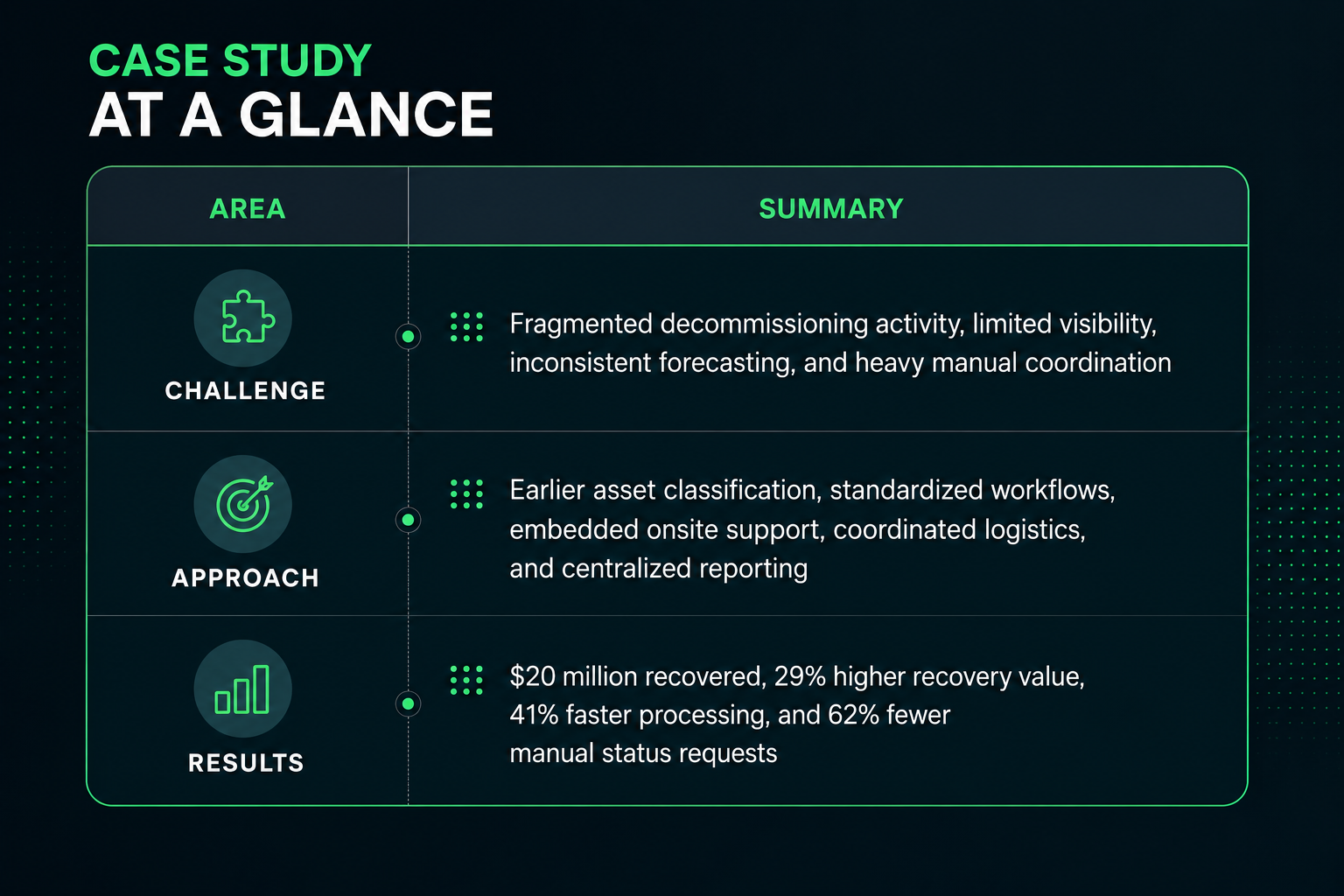
The hyperscaler was managing retired hardware across multiple facilities, vendors, OEM environments, and teams. Limited visibility, inconsistent forecasting, tight timelines, and separate systems made coordination difficult and increased manual follow-up.
The organization needed a more consistent way to manage assets without adding administrative burden.
Recovery outcomes depend on decisions made before equipment reaches the market.
Teams need to know what assets are available, when they can move, what condition they are in, and whether they should be resold, redeployed, refurbished, or recycled. When that information is fragmented, valuable equipment can sit too long or reach processing before its recovery potential is assessed.
By then, the best market opportunity may have passed.
Hardware value changes with supply, demand, product cycles, condition, configuration, and remaining useful life.
Some assets should move quickly. Others may be worth more through redeployment, refurbishment, or a different recovery channel.
The organization needed better information to decide what should move, when it should move, and where it could deliver the strongest outcome.
One of the most important changes was moving asset filtering and classification earlier in the lifecycle.
Instead of waiting until equipment arrived at a processing facility, teams began assessing recovery potential before decommissioning. They considered the asset type, manufacturer, configuration, condition, deployment status, security requirements, internal demand, market demand, and expected value.
This gave the organization more time to select the right path.
High-value hardware could be prioritized for resale or refurbishment. Assets with internal demand could be considered for redeployment. Equipment with little remaining value could move to responsible recycling without slowing the rest of the program.
Earlier classification also allowed recovery decisions to begin while decommissioning plans were still being finalized.
Visibility alone would not have solved the problem. The organization also needed consistent execution.
Mender implemented a centralized lifecycle management approach that included standardized processes, embedded onsite technicians, coordinated logistics, secure data destruction, asset tagging, and consistent reporting.
Onsite technicians acted as extensions of the customer’s internal team. They supported asset identification, tagging, coordination, and execution without placing more work on already constrained staff.
This created a repeatable operating model across 18 global data center locations and reduced the time lost to inconsistent local processes, unclear ownership, and fragmented vendor communication.
Recovery forecasts are difficult to trust when the underlying asset data is incomplete.
A forecast may be based on outdated inventory, assumed quantities, or equipment that is not yet ready for removal. It may also fail to reflect changes in condition, configuration, buyer demand, or project timing.
By improving access to expected asset volumes, categories, processing stages, likely recovery channels, historical performance, and upcoming decommissioning activity, the program gave teams a stronger basis for planning.
Forecasting became part of lifecycle planning rather than an estimate created after processing was already underway.
Standardized workflows helped equipment move through auditing, data destruction, testing, refurbishment, resale preparation, redeployment, and final disposition more efficiently.
More timely operational updates also reduced the need for teams to contact vendors, technicians, and regional stakeholders for basic status information.
Together, these changes helped the organization reduce avoidable delays and respond to market demand more effectively.
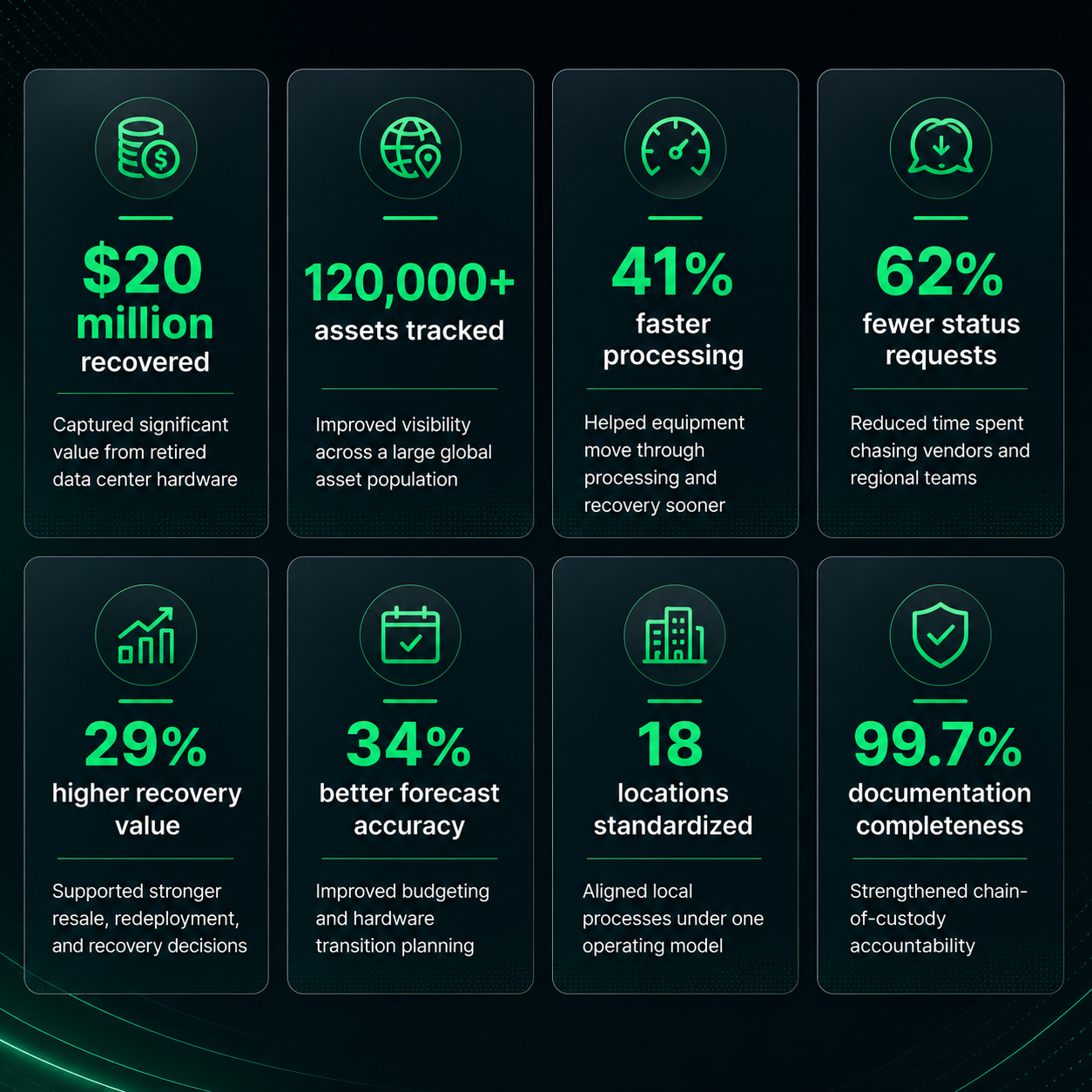
The program recovered $20 million from retired data center hardware.
That outcome was supported by earlier classification, stronger forecasting, faster processing, more consistent execution, and better market visibility.
The result was not driven by asset volume alone. It reflected better decisions about how and when assets moved through the lifecycle.
The organization reported a 29% improvement in recovery value.
Earlier classification and stronger market insight helped the team identify better opportunities across resale, redeployment, refurbishment, component recovery, and alternative buyer channels.
A higher asset count does not automatically produce a stronger financial result. Teams must understand which assets still carry value, where that value exists, and how quickly they need to act.
The program achieved a 41% improvement in asset processing speed.
Reducing delays between decommissioning, audit, sanitization, testing, and resale preparation gave the organization more control over when eligible equipment could reach the market.
Faster processing did not replace security or compliance requirements. It reduced unnecessary waiting between them.
The organization reported a 62% reduction in manual status requests.
Teams no longer needed to spend as much time chasing vendors and regional contacts for updates on collection, receiving, processing, documentation, or recovery status.
This reduced administrative work and improved accountability across the program.
The organization also reported a 34% improvement in recovery forecasting accuracy.
That supported better decisions around budgeting, refresh schedules, internal redeployment, expected resale proceeds, processing capacity, release timing, and recovery targets.
Recovery value could not come at the expense of governance.
Comprehensive tagging and tracking contributed to 99.7% chain-of-custody documentation completeness.
This gave security and compliance teams a stronger record of what happened to each asset while finance and operations tracked the recovery outcome.
The scale of this engagement was unusual, but the lessons apply more broadly.
Recovery potential should be identified before assets reach a warehouse. Market intelligence should be connected to current asset status. Approval and processing delays should be reduced wherever possible.
Operations, finance, security, compliance, and recovery teams should also work from a shared lifecycle record.
Most importantly, recovery should be managed as part of the asset lifecycle. Its outcome is shaped before pickup, during processing, and before final disposition.
Steward™ was not the platform used during the historical period covered in this case study.
Today, Steward™ applies the operating lessons behind this program by giving enterprise teams a centralized view of asset status, workflow activity, documentation, recovery intelligence, and final disposition.
It can help organizations reduce fragmented reporting, identify delays sooner, and connect operational activity with financial and compliance outcomes.
Hyperscaler IT asset recovery is the secure processing, redeployment, resale, refurbishment, or recycling of large volumes of data center hardware while seeking to preserve the highest reasonable value.
It requires coordination across facilities, vendors, security teams, logistics providers, operations, and finance.
Hardware values change as supply, demand, technology generations, and buyer requirements shift.
Delays in classification, approval, sanitization, or processing can reduce the number of available recovery options.
No. Processing must still meet security, testing, compliance, and documentation requirements.
However, reducing avoidable delays can help preserve market opportunity and give teams more control over timing.
More complete asset information, clearer processing status, historical performance data, and visibility into upcoming decommissioning activity gave teams a stronger basis for forecasting.
Steward™ gives teams one environment for asset status, workflow activity, documentation, recovery reporting, and final disposition.
It supports the visibility and coordination needed across multiple locations, vendors, and stakeholders.
The $20 million recovery was supported by earlier asset identification, standardized execution, improved forecasting, and faster decision-making.
The lesson for enterprise teams is clear: recovery value depends on timing, and timing depends on having the right information before the opportunity moves.
Mender brings the operational experience to manage complex recovery programs, while Steward™ gives today’s teams one command center for lifecycle activity, documentation, and outcomes.
Connect with our team to schedule a Steward™ walkthrough and see how stronger lifecycle visibility can support your next asset recovery program.
Spot the sneaky risks and learn to outsmart them.
Get a free asset quote today and let's get mending.
.jpg)
