Details
Date:
July 29, 2026
Author:
Mender Team
Clearing a data center on schedule is only part of a successful decommissioning. Assets must be accounted for, data secured, handoffs documented, and recovery opportunities protected throughout the process.
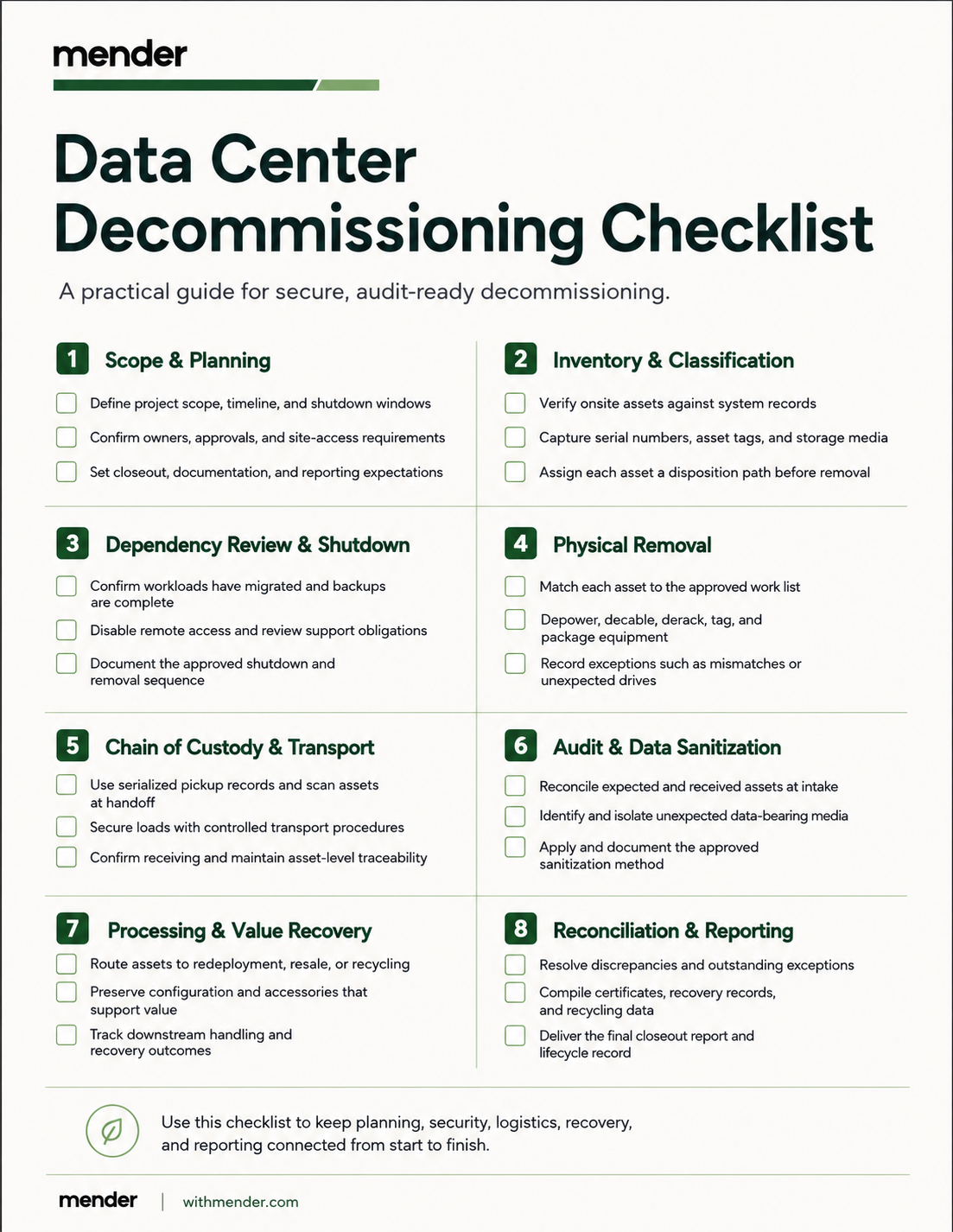
This article breaks down the eight stages required to manage decommissioning from planning through final reconciliation.
Data center decommissioning is the controlled retirement of infrastructure, equipment, data-bearing media, and supporting systems from an active facility or technology environment.
Depending on the project, this may include servers, storage systems, networking equipment, racks, power infrastructure, backup batteries, cooling systems, installed drives, spare components, and leased assets.
Organizations typically decommission a data center as part of a facility closure, cloud migration, consolidation, relocation, infrastructure refresh, or large-scale hardware replacement.
Because the process affects more than physical equipment, it requires close coordination across infrastructure, security, facilities, finance, procurement, compliance, sustainability, logistics, and IT asset disposition teams.

A successful decommissioning project begins before technicians enter the data hall.
The plan should define what will be removed, what must remain operational, who owns each decision, and what needs to be completed before the project can close. It should also cover site access, shutdown windows, data-security requirements, transportation controls, disposition priorities, and reporting expectations.
Ownership matters as well. Some equipment may be leased, OEM-managed, or subject to return agreements. Confirming those details early helps prevent assets from being removed without approval or routed through the wrong process.
Each stage should have a clear owner. Infrastructure may approve shutdown, security may define sanitization requirements, finance may authorize recovery decisions, and compliance may review final evidence.
These responsibilities should be established before execution begins, especially when multiple vendors or business units are involved.
A cleared facility is only one measure of success.
The project should also set expectations for inventory reconciliation, chain-of-custody completeness, data-bearing media control, documentation, recovery value, redeployment, recycling, and exception resolution.
A CMDB or asset register is a useful starting point, but it may not reflect what is physically installed.
Equipment may have been moved, reconfigured, stripped for parts, replaced without removal, or recorded under outdated identifiers. Storage media may also remain inside devices even when the inventory suggests otherwise.
An onsite inventory should confirm each asset’s manufacturer, model, serial number, asset tag, rack position, configuration, storage media, ownership, condition, and intended disposition.
Classification should happen before equipment reaches a processing facility.
Assets may be designated for redeployment, lessor return, resale, refurbishment, component recovery, recycling, or destruction. Making those decisions early gives teams more time to identify valuable equipment, internal demand, handling requirements, and data-security concerns.
Equipment should not be removed simply because it appears inactive.
Teams need to confirm that workloads have migrated, backups are complete, replication has finished, network connections are no longer needed, monitoring has been updated, and remote access has been disabled. Licenses, maintenance agreements, and OEM support obligations may also require review.
Rushing this stage can interrupt services, damage reusable equipment, or create gaps between the approved work list and what technicians find onsite.
The order of removal may depend on rack layout, power distribution, cable dependencies, equipment weight, nearby systems, destination, and data sensitivity.
That sequence should be documented and updated if onsite conditions differ from the original plan.
Once shutdown is approved, technicians can begin physical removal.
Each asset should be matched to the authorized work list, inspected, depowered, disconnected, deracked, tagged, and packaged for its destination.
Equipment intended for reuse or resale requires careful handling. Damage, missing components, and poor packaging can reduce recovery value or make the asset unsuitable for redeployment. Rails, power supplies, cables, bezels, and other useful accessories should remain with the asset when appropriate.
Technicians may discover serial-number mismatches, unexpected drives, damaged equipment, active connections, empty chassis, or third-party assets.
Those exceptions should be documented when found. Reconstructing them later increases the risk of missing context or leaving discrepancies unresolved.
Risk increases once assets leave the facility.
The organization should be able to show what left the site, when it moved, who released it, who received it, how it was transported, and where it arrived.
Serialized pickup records, scanning, sealed containers, controlled loading, verified transportation personnel, delivery confirmation, and secure receiving procedures can help maintain that record.
Chain of custody should cover the full journey from removal through processing and final disposition. It should also remain tied to each asset, since a transportation log that cannot be reconciled with serialized inventory provides limited assurance.
Assets should be audited when they arrive at the processing location.
The receiving audit should compare expected and actual assets, verify serial numbers, record condition, identify missing components, and isolate unexpected data-bearing media or other exceptions.
This stage can uncover risks that were missed earlier. In one published mender case study, an audit found more than 400 data-bearing drives still installed in servers after a previous provider had been contracted to remove them. Mender reports that the drives were quarantined, the client was notified, and the devices were returned for secure handling.
The sanitization method should match the media type, condition, information sensitivity, intended disposition, and organizational policy.
NIST SP 800-88 Rev. 2 recognizes Clear, Purge, and Destroy and emphasizes documented controls, verification, validation, and evidence. The selected method and result should be tied to the specific asset or media record.
R2v3 also provides guidance on traceability, recordkeeping, verification, quality controls, and downstream vendor oversight.
Once audit and data-security requirements are complete, each asset should move to its approved outcome.
Some equipment may still be suitable for internal redeployment. Other assets may be tested, repaired, reconfigured, graded, and prepared for resale. Equipment without a viable reuse path should move through qualified recycling channels with clear records of downstream handling and final disposition.
The goal is to choose the most appropriate secure outcome rather than treating destruction or recycling as the default.
The project is not complete when the final truck leaves the facility.
The physical work must be reconciled against the original scope, receiving records, processing results, sanitization evidence, and final disposition.
The closeout package should show what was planned, what was removed, what was received, which discrepancies occurred, what happened to each data-bearing device, and which assets were redeployed, sold, refurbished, recycled, or destroyed.
It should also connect recovery and environmental outcomes to the underlying asset activity.
Final reporting may include serialized asset records, chain-of-custody documentation, reconciliation results, sanitization or destruction certificates, recovery reports, recycling evidence, exception logs, and the final closeout summary.
1. Records Do Not Match Reality
Outdated inventories can lead to missed assets, late discoveries, and unclear disposition decisions.
2. Data Security Starts Too Late
Storage media should be identified and controlled before assets reach the processing site.
3. Documentation Falls Behind
Records should be updated as work happens so assets, certificates, and final outcomes remain aligned.
4. Recovery Decisions Are Delayed
Classifying assets earlier gives teams more time to choose between redeployment, resale, refurbishment, recycling, or destruction.
A platform does not replace the technicians, logistics controls, sanitization processes, or recovery channels required to complete a decommissioning project.
Its value is in connecting the activity and evidence across those stages.
Steward™ provides centralized visibility into service orders, asset movement, chain-of-custody records, processing status, data-destruction documentation, exceptions, recovery tracking, and final disposition.
It can also extend visibility beyond ServiceNow or an existing CMDB by showing what happens after equipment leaves active use.
A successful decommissioning project connects planning, security, logistics, recovery, and reporting from the start. When those stages operate separately, risk increases and critical information gets lost between teams and vendors.
Mender provides the operational expertise to execute the work, while Steward™ gives enterprise teams one command center to track every asset, handoff, document, and outcome through final reconciliation.
Connect with our team to schedule a Steward™ walkthrough and see how one connected lifecycle view can support your next decommissioning project.
The timeline depends on facility size, asset volume, operational dependencies, access requirements, security controls, and disposition strategy.
A smaller equipment removal may take several days, while a multi-site or phased program may continue for months. Inventory verification and dependency planning should occur before the final removal schedule is approved.
Data center decommissioning covers shutdown, dependency management, disconnection, physical removal, and facility clearance.
ITAD manages the secure downstream handling of the retired assets, including auditing, data sanitization, redeployment, resale, recycling, and documentation. Mature programs connect both activities through one workflow.
Initial valuation should begin during planning and classification.
The estimate can be refined after configuration and condition are verified. Waiting until final processing may reduce the time available to respond to market demand.
The requirements depend on organizational policy, asset type, and applicable standards. Common deliverables include serialized inventories, chain-of-custody records, reconciliation reports, sanitization or destruction certificates, recovery records, recycling documentation, and an exception log.
NIST SP 800-88 Rev. 2 provides current guidance for establishing and operating a media sanitization program. Organizations may also use requirements from R2v3, IEEE 2883, NSA specifications, or another organizationally approved standard, depending on the media and operating environment
Spot the sneaky risks and learn to outsmart them.
Get a free asset quote today and let's get mending.

.jpg)